
Lloyd’s has recorded a 6.9% rise in gross written premium (GWP) to £34.7bn for the first half of 2026, up from £32.5bn in H1 2025. The increase was driven by strong volume growth of 15.8% from new and existing syndicates, despite a more competitive pricing environment.

For the six-month period, the Lloyd’s market delivered an underwriting result of £1.9bn, with a combined ratio of 90.8%, benefiting from comparatively lower major claims. This compares with £1.5bn and 92.5% in H1 2025. However, the underlying combined ratio increased slightly to 84%, from 82.1% in H1 2025, as risk-adjusted rates reduced.
The major claims ratio improved to 6.8% from 10.4% in H1 2025, due to a comparatively lower level of catastrophe losses. Prior-year reserve releases contributed 3.5 percentage points, up from 2 percentage points in H1 2025, reflecting favourable movement across multiple classes. This was partly offset by reserve strengthening on the Baltimore Bridge loss and updated Ukraine estimates. The expense ratio rose slightly to 36.4%, from 35.8% last year, due to higher acquisition costs and increased profitability-driven commissions.
For the first half of 2026, Lloyd’s generated profit before tax of £3.5bn, a decrease on the prior-year period’s £4.2bn.
On the asset side, Lloyd’s saw decreased investment returns of £1.8bn, or 1.6%, affected by unrealised fixed income losses following a widening of yields in the period. This compares with £3.2bn, or 3.1%, in H1 2025.
Lloyd’s explained the investment performance. “The result comprised strong income and realised gains, whereas unrealised losses detracted from performance. Yields widened during the period as geopolitical tensions and inflationary pressures resulted in downward pressure on fixed income assets. Equity markets, by contrast, performed strongly and provided a partial offset. The market’s portfolio remains focused on high-quality asset allocation, capital preservation and liquidity,” it said.
As at 30 June 2026, Lloyd’s capital position remained strong, with total capital, reserves, and subordinated loan notes of £48.4bn, compared with £49.8bn in FY 2025. Underlying capital generation in H1 2026 was offset by the return of capital to members, reflecting the strong performance of the closing underwriting year of account.
The Lloyd’s central solvency ratio increased to 503% in H1 2026, compared with 496% at FY 2025, while the market-wide solvency ratio remained broadly stable at 199%, compared with 200% at FY 2025.
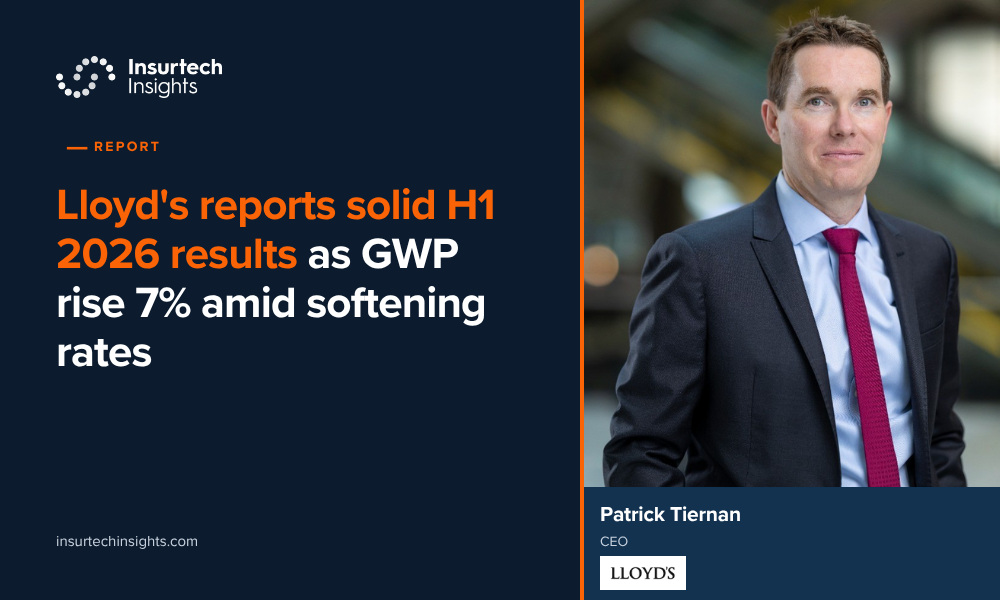
Patrick Tiernan, chief executive officer of Lloyd’s, said the market had delivered a solid performance.
“The syndicates operating in the Lloyd’s market delivered a solid aggregate set of results for the six months ended 30 June 2026. But performance and high risk are far from mutually exclusive. Underwriting discipline and innovation are the keys to maintaining outperformance and quality of earnings,” said Tiernan.
Alongside its results, Lloyd’s reaffirmed that the market remains on track to deliver against the full-year guidance set out in March. The strategy is focused on deploying Lloyd’s four distinctive strengths to sharpen its financial edge.