Insurers are automating decisions faster than they are building the infrastructure needed to verify the information behind them, according to new research from Clearspeed, the voice-based risk assessment provider.
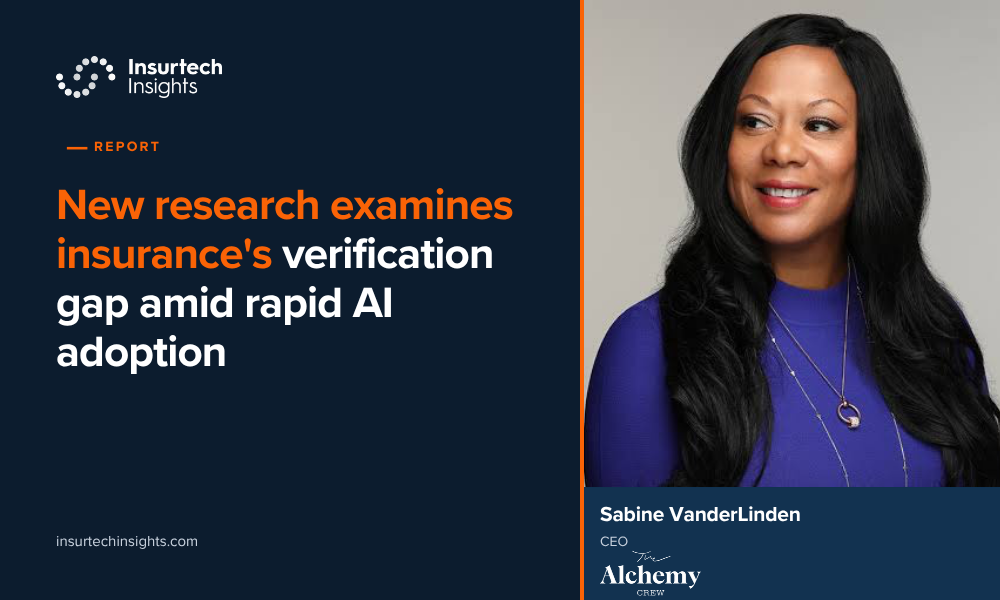
The report, “The Speed of Trust: Building the Trust Intelligence Layer for Insurance in the Age of Agentic AI”, was commissioned by Clearspeed and independently authored by insurance innovation strategist Sabine VanderLinden, chief executive officer of Alchemy Crew Ventures. It draws on a review of 76 public filings from 49 insurers and reinsurers, 31 industry studies, and 16 interviews with claims and underwriting leaders across the United States and United Kingdom.
The research identifies a paradox emerging as insurers rapidly adopt AI and automation. The industry is automating decisions, handoffs, evidence review, and customer interactions faster than it is building the infrastructure needed to clear those interactions confidently. At the same time, AI is making it faster and easier to create convincing false or manipulated photos, documents, voices, and identities that can enter insurance workflows.
Reserving against a risk not yet named
Industry research published in March 2026, based on a survey of 300 US insurance claims professionals, found that 98% agree AI editing tools are driving a rise in digital media fraud, while just 32% say they are very confident they could identify a deepfake.
“That is the verification gap: the distance between what the industry can see coming and what it can currently detect,” said VanderLinden. “Insurance is automating decisions faster than it can verify the information behind them.”
Alchemy Crew Ventures researchers searched 76 annual reports, 10-K filings, proxy statements, and statutory returns from 49 insurers and reinsurers for a dozen terms related to AI-generated and manipulated evidence, media, and imagery. The analysis found zero mentions of synthetic media, synthetic identity, or voice cloning across all 76 filings. Just six of the 49 companies mentioned deepfakes, and only as a cybersecurity concern, never in connection with evidence used in claims or underwriting decisions. Of the five of the world’s top 10 reinsurers analysed, none mentioned deepfakes, synthetic media, or AI-generated evidence in their most recent annual reporting.
“There is a striking gap between where this risk is discussed and where capital is committed,” said VanderLinden. “In the filings that set reserves, uncertainty, litigation pressure, and adverse development are all named. The trust problem beneath them is not.”
Genuine customers are paying the price
Most claimants are genuine. According to the Coalition Against Insurance Fraud, fraud accounts for roughly 10% of property and casualty losses, with the trust deficit draining at least $308.6bn annually from the US insurance system.
However, the deeper issue is not simply the cost of fraud. Until insurers have a consistent way to determine which interactions need speed, scrutiny, or human judgment, the industry pays for trust twice: once through leakage from the few bad actors, and again through friction imposed on the genuine majority.
“90%+ of customers who make a claim are honest, good people for whom we should be just sorting out their service needs as quickly as possible,” Ian Thompson, former group chief claims officer at Zurich Insurance, told researchers. “But how many of those genuine customers get the feeling that they’re not being trusted, because we’re trying to catch the other 10%?”
Making the trust intelligence layer operational
In the report, VanderLinden argues that insurers should address this challenge by making trust a measurable infrastructure layer across the policyholder journey.
Rather than using more AI merely to catch more fraud, insurers should establish a Trust Intelligence Layer: a continuous, regulator-ready risk indicator running across the policyholder journey, designed to help insurers clear the genuine majority quickly while directing human judgment to the exceptions. The signal informs a decision rather than making one, produces an audit trail rather than an automated denial, and does not require demographic or historical knowledge of the individual being assessed.
“In the age of agentic AI, deepfake evidence, embedded distribution, and automated workflows, insurers can no longer treat trust as a soft value or a late-stage consideration. The opportunity for carriers is to establish trust earlier and make it a measurable operating layer across the policyholder journey,” said VanderLinden.
“Trust is our most vital currency: it is the hardest thing to gain and the easiest thing to lose,” said Alex Martin, co-founder and chief executive officer of Clearspeed. “Today’s promise of AI should yield a faster, richer experience for genuine customers, but that must begin with verifying where to extend trust.”
Vision 2030: trusting the conversation
The report also looks ahead to 2030, when a material share of insurance interactions will be agent-to-agent: a customer’s AI agent transacting with an insurer’s AI agent, at machine speed, with no human in the loop for routine business. In that world, the report argues, the verification question does not disappear; it migrates and intensifies. When the action is always executed correctly, the question left is whether the interaction behind it can be trusted.
The report describes this as a shift in what gets verified, not whether verification is still needed. As more insurance interactions become AI-to-AI, the human input behind each transaction still has to be trusted before automated systems act on it. Insurers will need an auditable way to establish that trust at the moment of interaction, and the organisations that build that capability now, while interactions are still human-led, will define the standard when those interactions become machine-to-machine.
The report concludes that “the arms race is symmetrical. The only durable advantage is to establish trust earlier and faster than the adversary can manufacture doubt.”