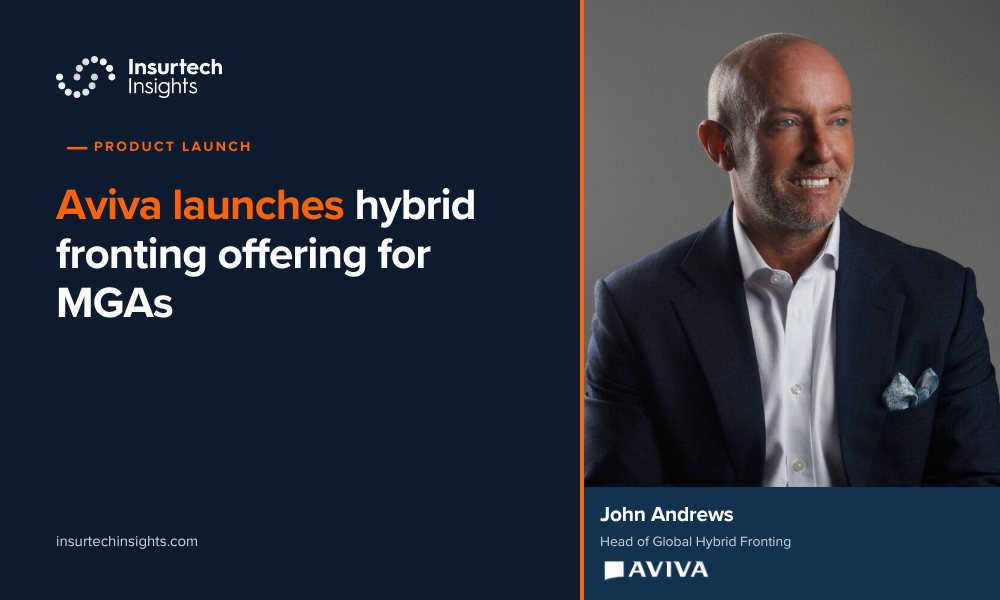
The UK-listed carrier announced the launch of the unit on Monday, part of a drive to expand its presence across the global commercial lines market. The offering, delivered through Aviva’s Global Corporate & Specialty business, combines fronting capacity with meaningful risk retention and is designed for larger, established MGAs running multi-country, multi-line programmes.

Andrews said the Aviva brand and balance sheet could help MGAs attract broker and client support.
“They get the kudos in the market from having Aviva paper and Aviva backing. They can go to their retail brokers and say: ‘We’ve got AA-rated paper, a huge balance sheet and global capabilities – partner with us,'” he said.
The volume of MGA-generated premium flowing into the reinsurance market has increased rapidly. Gallagher Re’s composite of 25 North American program carriers ceded $21.2bn to reinsurers and captives in 2025, up 18% year on year and 59% from 2023. That growth has been led by the largest reinsurers: assumed MGA premium rose 84% at Hannover Re during 2025, 74% at Munich Re, 51% at Lloyd’s, and 49% at Allianz. Together, these four markets accounted for 82% of the increase in assumed premium among the top 50 counterparties.
However, that growth has coincided with greater scrutiny of the financial and operational risks created when insurers issue policies but transfer most of the exposure to reinsurers. Conning said in its latest fronting study that reinsurance credit management, underwriting oversight, and institutional capital support were becoming increasingly important as the sector matured.
Some fronting carriers have reported significant losses tied to program business. As The Insurer reported, Markel booked a $205m reserve after collateral supporting reinsurance recoverables at State National proved insufficient following a capacity provider’s bankruptcy.
Andrews and Gordon believe Aviva’s established brand, AA-rated paper, underwriting infrastructure, and larger balance sheet can give reinsurers access to MGA portfolios, while reducing some of the alignment and counterparty concerns associated with smaller specialist fronts.
How Aviva’s model works
Aviva said it would provide capacity for a defined segment of an MGA’s business, rather than its entire portfolio. For example, an MGA already writing £100m of premium might approach Aviva for capacity to write an additional £30m. Aviva could provide the full capacity for that agreed £30m segment, with the MGA’s existing £100m book supported by other carrier relationships.
Within the additional portfolio, Aviva would retain approximately 15% of the risk on average – £4.5m in this example – while a panel of reinsurers would assume the remaining £25.5m through quota-share arrangements.
“We will be absolutely underwriting it, and we want reinsurers to come on that journey with us,” Gordon said.
The platform will consider monoline and multiline MGAs, depending partly on reinsurer demand. Opportunities must be writing at least £20m or $25m of premium, with Aviva targeting between 10 and 30 MGA relationships within three years.
Deals will typically run for three years but can extend to five. Aviva will primarily use company paper across the UK, US, and Europe, while its Lloyd’s platform can provide access to additional territories. Its appetite will focus on specialty risks and exclude some of the longest-tailed classes, including workers’ compensation and auto liability.