
Six syndicates have taken a combined 15% share of Ryan Specialty's global delegated book, as Lloyd's identifies consortium-led facilities as a primary growth vehicle for 2026.

Six syndicates have taken a combined 15% share of Ryan Specialty's global delegated book, as Lloyd's identifies consortium-led facilities as a primary growth vehicle for 2026.
Lloyd's has named consortium-led facilities a major growth area for 2026, and the market is responding. Ryan Specialty Underwriting Managers (RSUM) completed a series of Lloyd's consortium stamps on 6 July, with six syndicates taking a combined 15% share across RSUM's global P&C delegated underwriting portfolio.
The deal arrived alongside another consortium move in the same month. BMS Group launched a specialist consortium broking unit in June 2026, citing the Lloyd's Q4 2025 Market Messages, which named structured solutions and consortium-led facilities as a major expected growth area for 2026. The back-to-back moves point to a coordinated market shift.
Structure and Digital Infrastructure
The consortium stamps cover all classes, lines, and geographies. The arrangement excludes a partial share of Velocity Risk Underwriters, RSUM's catastrophe managing general underwriter. Markel acted as cornerstone syndicate, and facilities will begin joining at their natural renewals from 1 August.
Ardonagh's technology-enabled digital exchange, Axiiem, will serve as the facilitation agent. Axiiem launched days before the RSUM deal and draws on seven years of Ardonagh's proprietary group data to attract portfolio flows that have historically stayed in domestic markets. Its role in the RSUM transaction is one of the first live applications of the platform in a structured Lloyd's facility.
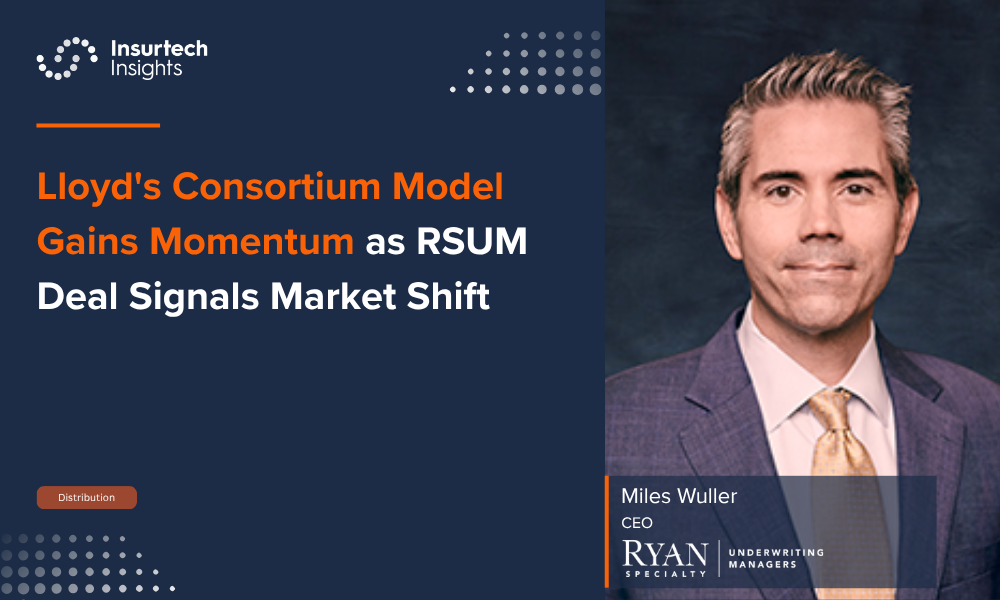
Miles Wuller, CEO of RSUM, said the deal showed continued demand for the unit's delegated portfolio.
"We are proud of both the continued interest in our portfolio and our ability to transform our diverse, highly curated, well-performing family of businesses into an accessible specialty insurance asset," he said.
A Shifting Model for Lloyd's Capacity
Industry analyst David Hardcastle said consortium arrangements have moved from "a nice to have" to a routine component of syndicate planning. He noted that structures ranging from quota shares to Lloyd's consortiums now serve the same purpose: the flexible deployment of capital and underwriting authority. That framing places the RSUM deal within a wider pattern of how syndicates are restructuring capacity access.
The broader market numbers support that direction. Delegated authority accounts for approximately 45% of Lloyd's premium income, according to Lloyd's. The market's 2026 business plan projected £67.4 billion in gross written premium, with 62.5% of accretive growth expected from new entrants and structured solutions. Lloyd's syndicates posted a weighted average underwriting result of 18.8% of net premium earned in 2025, according to Syndicate Research Limited.
As delegated authority moves towards becoming the majority of Lloyd's business, the RSUM deal illustrates how consortium-led facilities, supported by digital trading infrastructure, are fast becoming a central mechanism for deploying capacity in the specialty market, rather than a peripheral option.