
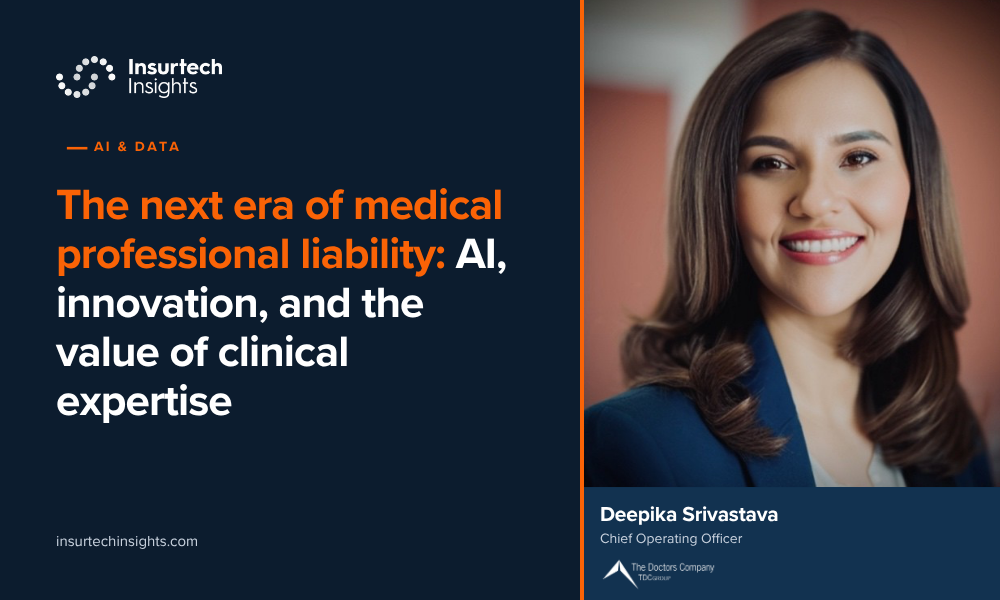
AI is reshaping risk across insurers, clinical settings, and patient behaviour. However, in the medical professional liability (MPL) market, viewing it only as a faster underwriting tool misses the larger opportunity, according to Deepika Srivastava, chief operating officer of The Doctors Company, part of TDC Group. In an opinion piece, she argues that the next era of MPL should use technology to deepen the industry's understanding of medicine, care delivery, and emerging exposures, so that physicians have the protection they need to focus on patient care.

Srivastava traces the modern MPL market back to the malpractice crisis of the 1970s, when rising claims, escalating premiums, and carrier exits forced physicians to build organisations dedicated to protecting the practice of medicine. From the start, she notes, MPL has demanded more than actuarial calculation and policy administration, requiring specialised knowledge of clinical practice, healthcare delivery, and the organisations responsible for patient care. That dedication matters even more today, as healthcare and MPL are tested by consolidation, more complex care models, heightened public scrutiny of medicine, and a more volatile litigation environment.
Malpractice claims develop over several years and involve a wide range of variables, including specialty, procedure, jurisdiction, communication, documentation, and outcome. Srivastava argues that insurers with mature claims data and decades of experience have a significant head start when using AI to identify patterns and translate them into better-informed underwriting and claims decisions. There is a clear opportunity, she says, to make institutional knowledge more accessible, processing predictable risks efficiently while preserving expert judgment for complex exposures. Yet speed alone is not enough: a multi-regional medical organisation operating across different states is an entirely different risk profile than an individual physician. While many parts of insurance are overdue for modernisation, she contends that MPL is too closely tied to patient care, physician judgment, and long-tail liability to be entrusted to AI alone.
Understanding the medicine behind the data
As physicians and healthcare organisations adopt AI-enabled tools and new care models, Srivastava argues that underwriting must evolve with the risk. Virtual ICUs, telehealth, hospital-at-home programmes, remote patient monitoring, and clinical decision support fundamentally alter where care happens, how decisions are made, and how accountability is evaluated across increasingly integrated healthcare systems.
Malpractice law, she notes, has not kept pace with clinical AI adoption. Healthcare practitioners still retain responsibility for AI-influenced decisions, and courts continue to apply traditional negligence frameworks to this new risk. Governance, documentation, and oversight may shape how liability is evaluated years later, even as legal standards and claims experience are still developing.
An insurer cannot wait for a mature claims history before evaluating the risk, Srivastava writes, because by the time a reliable pattern emerges, the technology, care model, or delivery system may already have changed. Even established physician risks show why context matters. Two physicians in the same specialty, practising in the same state, and performing many of the same procedures may appear similar in a data set, yet their actual liability exposure can differ materially based on patient acuity, procedural mix, practice setting, staffing, protocols, follow-up practices, and the systems surrounding the patient encounter.
Innovation across the lifecycle of risk
AI has meaningful potential across the lifecycle of risk, Srivastava says, from organising complex records and identifying claims patterns to recognising potential severity earlier. Routine underwriting should become more efficient as the technology improves, with significant room for automation across the industry.
However, she cautions that market narratives equating AI with instant pricing oversimplify the exposures MPL was built to understand. Physicians now practise in a public environment that looks vastly different from even a decade ago. An adverse outcome can become the subject of social media commentary before the clinical facts are understood, and individual cases can be swept into broader narratives about physicians, hospitals, or the healthcare system, while large verdicts and social inflation are changing the economics and stakes of medical liability litigation. Patients, meanwhile, are using AI to question their care and their symptoms.
Physicians need the strength and scale of an MPL carrier prepared to defend them in a litigation and social environment that is far more contentious than previously imagined, Srivastava argues. More than 80% of US counties, representing 120 million Americans, still lack adequate access to healthcare services. MPL's role, she says, is not simply to price risk but to help preserve the stability physicians and healthcare organisations need to continue delivering care, requiring experienced underwriters and claims professionals who understand the data, ask better questions, and recognise what is at stake beyond the policy itself.
Innovation has to reflect MPL's physician-owned roots
AI will continue to transform underwriting, claims, and every facet of the insurance business, Srivastava concludes. But innovation in MPL must reflect why the market exists: it was built by physicians to stand with physicians and healthcare organisations when the practice of medicine is under pressure. The same principle, she argues, should guide AI's role in medicine itself, reducing administrative burden, supporting earlier insight, and strengthening, rather than diluting, the physician-patient relationship.
The real opportunity, she writes, is to use innovation to expand what experienced professionals can see, evaluate, and act on, without ever substituting technology for the judgment patients and physicians depend on. That is the standard the next era of MPL should be held to: not how quickly a policy can be priced, but whether the industry still does what it was created to do, understanding the practice of medicine well enough to stand behind the people who practise it.


