
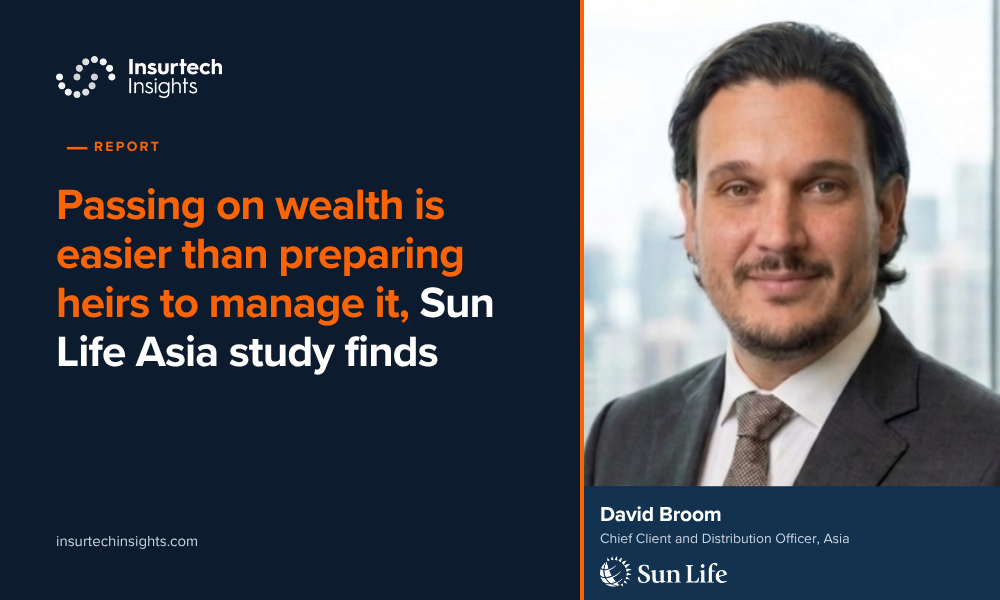
New research from Sun Life Asia reveals that the biggest threat to preserving wealth across generations may not be market volatility or family conflict, but whether beneficiaries are ready to manage what they inherit. While legacy planning is becoming more common across Asia, only one in five people say they feel fully prepared to pass on their legacy today.

Sun Life Asia's latest report, "Passing the Torch: When legacy means more than money", found a significant shift in how people across Asia think about the legacy they want to leave behind. Nearly three-quarters (74%) of people surveyed intend to pass on values, knowledge, or life lessons as part of their legacy plan, alongside financial assets. At the same time, 70% worry their wealth may not be preserved beyond the next generation, and only 20% say they feel fully prepared to pass on their legacy today.
The study also found that legacy planning continues to gain momentum across the region. The proportion of people with a fully documented and communicated legacy plan more than doubled, from 10% in 2025 to 22% in 2026, while the proportion with no plan at all fell from 31% to 15%.
David Broom, chief client and distribution officer at Sun Life Asia, said a written plan was not enough on its own.
"A legacy plan is not complete simply because it's been written down. It needs to give families a shared understanding of what the wealth is for, what principles should guide its use, and how the next generation can carry that responsibility forward. That is how planning on paper becomes something that can endure in practice," said Broom.
Legacy means more than money
For most families, legacy means more than money. Skills and education (33%), family values (32%), and life lessons (31%) rank among the things people most want to leave behind, alongside money and property. Providing opportunity through education carries particular weight, ranking among the region's top three legacy priorities overall (48%). Even among those planning to leave financial assets, funding education (45%) sits just behind providing financial support to family members during their lifetime (50%) and essential family needs (52%).
What families want their wealth to achieve tells the same story. Six in 10 (61%) want it to create long-term opportunity for the people they love, and 52% want it to cover essentials such as housing and healthcare.
Planning is developing faster than confidence
Planning is becoming more disciplined, but confidence has not moved with it. While the number of people with a fully documented and communicated plan has more than doubled in a year, only 20% of people feel fully prepared today, almost unchanged from 19% a year ago.
Professional advice is closely associated with greater preparedness. Nearly half of those surveyed (46%) have sought professional legacy planning advice, up from 37% in 2025. Among them, 79% feel financially prepared for their legacy, compared with 44% of those who have not sought advice but would like to.
Anxiety is highest among those with the most time to plan. Three-quarters (76%) of Gen Z and Millennials worry their wealth won't last, against 66% of Gen X and 59% of Baby Boomers. Yet younger people are also the most optimistic about the reach of what they leave, with 65% of Gen Z and 67% of Millennials believing their wealth will have a lasting, multi-generational impact, compared with 51% of Baby Boomers.
Whether beneficiaries are ready to manage what they inherit is families' single biggest concern, cited by 52% of those worried their wealth won't last, ahead of market volatility (49%) and conflict over assets (44%). More than a quarter (27%) name a lack of financial literacy in the next generation as one of the greatest risks to preserving family wealth, and a further 25% worry the next generation will lack the confidence to manage what comes their way.
Broom added: "Passing on wealth can be a straightforward decision, but preparing someone to manage it is a much longer process. Families that involve the next generation early can use those conversations to build financial judgment, clarify expectations and reduce uncertainty before responsibility changes hands. A trusted financial advisor can help families navigate those conversations with greater confidence and turn good intentions into a plan that everyone understands."
For wealthy families, managing complexity matters more than managing conflict
For Asia's wealthiest families, the picture looks different. Where the general population worries most about family readiness and the risk of conflict over assets, high-net-worth individuals are far less concerned by the prospect of a family falling out. One-fifth (20%) see disputes as a major threat to preserving wealth, compared with 34% across the general population surveyed.
Their concerns lie instead with the fundamentals of preserving wealth: making the right investment decisions, managing tax and legal complexity, and having confidence in the institutions that manage it. Poor investment decisions are seen as a risk by 37% of high-net-worth respondents, compared with 24% of the general population, and 29% point to tax or legal complexity, against 18%. Among those worried their wealth may not be preserved beyond the next generation, 40% cite confidence in the advisors or institutions managing their wealth, versus 25% of the wider group.
More than eight in 10 (83%) of high-net-worth individuals surveyed believe advisors should play a role in legacy planning, and 63% think advisors should take the lead.
Sujoy Ghosh, chief executive officer of Sun Life Private Wealth, said trusted advice was critical for these families.
"Preserving wealth for high-net-worth families is not simply about avoiding family conflict. Having confidence in the decisions that shape that wealth, from investments to how it is structured for the next generation, is equally important. That makes trusted advice critical. Families increasingly need advisors who can bring the right expertise together, navigate complexity and help them make sound decisions across borders and generations," said Ghosh.


